
The timing is much better now than it was when the original Georgia Music Hall of Fame failed. Macon has developed something it largely did not have then: an actual music-tourism ecosystem.
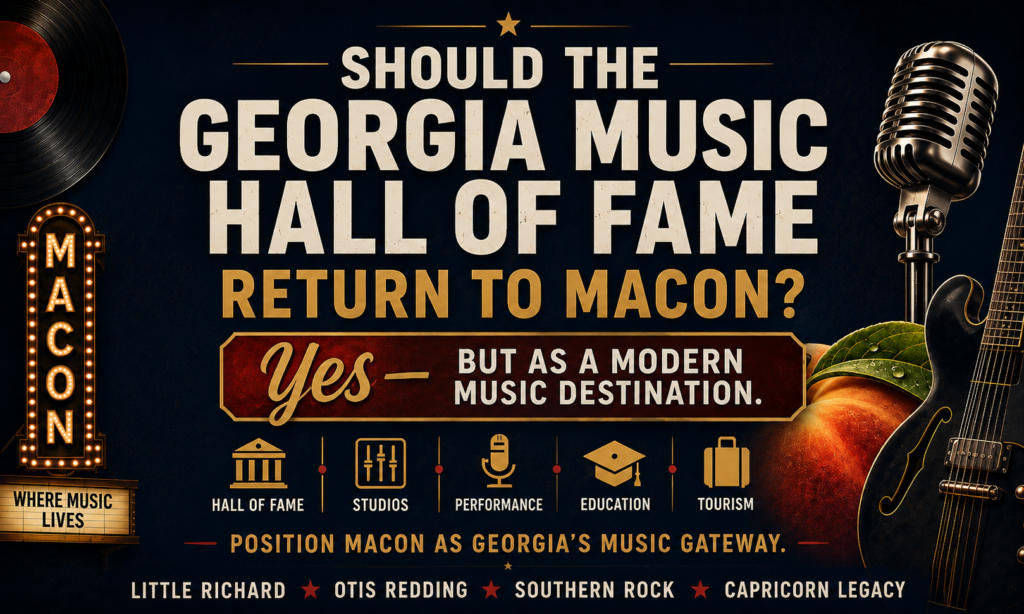
My recommendation would be to position Macon for a future Georgia Music Hall of Fame + Music Heritage Center, but make it a functioning part of the city’s tourism, recording, education and live-event infrastructure rather than another large state-supported artifact museum.
Why the first one failed
The original Hall of Fame had legitimate educational value. At one point it attracted more than 48,000 schoolchildren annually. But attendance and revenue declined, the state ended its operating support in 2010, and the museum closed in June 2011. Most of the collection ultimately went into archival storage at UGA. (Georgia Encyclopedia)
That history matters because the lesson isn’t:
“A music museum can’t work in Macon.”
The lesson is:
“A large standalone museum dependent on state appropriation and paid admissions wasn’t economically sustainable.”
Those are very different conclusions.
Macon in 2026 is a different proposition
Macon now has a remarkably concentrated collection of music assets.
There is the Allman Brothers Band Museum at the Big House, Otis Redding attractions and the new Otis Redding Center for the Arts, Capricorn, music tours, live venues, festivals and a Music Trail app. Visit Macon is actively marketing music as one of the city’s defining tourism products. (Macon, GA)
Perhaps most important is what happened at Capricorn.
Mercer transformed the old Capricorn complex into an approximately 20,000-square-foot working music facility combining historic interpretation, commercial recording studios, education, events and performances. (School of Music)
And it is actually being used. Capricorn reports more than 700 recording sessions since its restoration, including contemporary recording artists. (Mercer Music at Capricorn)
That is precisely the model Macon should learn from.
History + production + education + events + tourism.
Not history sitting behind glass.
The tourism numbers strengthen the case
Macon-Bibb visitor spending reached approximately $476.1 million in 2024, up 3.9%, while hotel-motel tax collections exceeded $6.6 million, another record. Visit Macon also reports that Macon was one of three nominees for a 2025 Global Music City designation. (Macon, GA)
Macon’s tourism operation is now explicitly treating tourism as an economic-development sector rather than an auxiliary civic activity. (Georgia Entertainment)
That gives a revived statewide music institution something the old Hall lacked:
an increasingly mature destination surrounding it.
A tourist coming for the Hall today could spend a weekend doing:
- Georgia Music Hall
- Capricorn
- Big House
- Otis Redding
- H&H
- Rose Hill
- Little Richard sites
- live concert
- downtown restaurants
- Macon Music Trail
That is a much stronger tourism proposition than:
Drive to Macon. Visit museum. Drive home.
Macon’s strongest argument: Georgia music actually happened here
Atlanta has a far larger modern music industry.
Athens has extraordinary alternative-rock history.
Augusta has James Brown.
Albany has Ray Charles.
Savannah has substantial music and cultural history.
Georgia’s own economic-development agency presents the state’s music heritage as geographically distributed among these places. (Georgia)
But Macon’s distinction is unusual.
It isn’t primarily:
“A famous musician came from here.”
It is:
“Important periods of American music were created here.”
Consider the convergence:
Little Richard → rock and roll
Otis Redding → soul
Phil Walden / Capricorn → Southern rock
Allman Brothers → Southern rock/jam tradition
And Macon has original physical places associated with these stories.
Capricorn isn’t a reconstruction.
The Big House isn’t an interpretive building erected somewhere else.
Rose Hill isn’t a themed attraction.
The geography itself is part of the story.
That gives Macon an authenticity advantage.
I would give Macon an 8.5/10 as the future home
If Georgia wanted a physical statewide Music Hall of Fame again, I’d rank the contenders roughly this way:
| City | Case |
|---|---|
| Macon | Best heritage/tourism location |
| Atlanta | Best contemporary industry/business location |
| Athens | Excellent music culture but narrower statewide story |
| Augusta | Powerful James Brown connection but narrower ecosystem |
| Savannah | Strong tourism infrastructure but weaker statewide music claim |
Atlanta would win if the institution were primarily an industry headquarters.
Macon wins if it is supposed to tell the Georgia music story.
And that distinction should become part of the pitch:
Atlanta is where much of Georgia’s music business operates. Macon is where some of Georgia’s most consequential music history happened.
But I would change the entire concept
I wouldn’t call for rebuilding the old Georgia Music Hall of Fame.
I’d propose something closer to:
Georgia Music Hall
Museum • Archive • Studios • Performance • Education
Think less traditional museum and more Georgia’s music headquarters for the public.
It could contain six interconnected components.
1. Georgia Music Hall of Fame
A relatively compact permanent Hall.
Inductees across:
Soul
Rock
Country
Gospel
Hip-hop
R&B
Jazz
Classical
Songwriting
Production
Broadcasting
Digital displays could prevent the collection from becoming enormously expensive to rotate.
2. Georgia Music Experience
This is where the money should go.
Rather than endless display cases:
Georgia Soul
Macon & Southern Rock
Athens 1977–1995
Atlanta Hip-Hop
Georgia Country
Georgia Gospel
Georgia Songwriters
Georgia Studios & Producers
Immersive sound, projection, video and interactive recording experiences.
The building becomes something people actually want to revisit.
3. Georgia Music Archive
This could reconnect publicly accessible interpretation with material already preserved elsewhere rather than demanding that every original artifact permanently relocate to Macon.
The original Hall’s collection largely went to UGA after the closure. (Georgia Encyclopedia)
That suggests a smart institutional partnership:
UGA preserves.
Macon interprets and exhibits.
Mercer teaches and produces.
Different institutions doing what they’re good at.
4. Working production
This is essential.
Podcast studio.
Broadcast studio.
Video studio.
Small recording rooms.
Oral-history studio.
Artist interviews.
Concert recordings.
Hall of Fame induction programming.
Documentaries.
YouTube.
Streaming.
Suddenly your museum produces intellectual property continuously.
5. Performance
Maybe a 300–800 seat room, depending upon the ultimate facility.
That permits:
Hall of Fame ceremonies
songwriter nights
tribute performances
student showcases
album releases
industry panels
concert tapings
educational programs
That changes the economics dramatically.
6. Georgia Music Trail headquarters
This is where I think Macon could claim something much bigger than a museum.
Make the facility the starting point for a statewide:
GEORGIA MUSIC TRAIL
Macon
Atlanta
Athens
Augusta
Albany
Savannah
Columbus
Rome
and other associated sites.
Explore Georgia already promotes Georgia music tourism across multiple communities. (Explore Georgia)
Macon doesn’t have to claim:
“All Georgia music belongs to us.”
It can claim:
“This is where you begin exploring Georgia music.”
Politically, that’s much easier for the rest of the state to support.
And this actually changes how I see your 1985 Vineville idea
The concept we’ve been discussing for Walden Auditorium / Visit Macon / recording / presentation / tour operations suddenly has a substantially stronger institutional narrative.
Rather than pitching 1985 Vineville simply as another entertainment venue, it could eventually be positioned as part of a larger:
Macon Music Gateway
Imagine the visitor flow:
Georgia Music orientation presentation
↓
Walden Auditorium
↓
Macon Music transportation/tours
↓
Big House
↓
Rose Hill
↓
Capricorn
↓
Otis Redding
↓
Downtown / H&H
↓
Little Richard
↓
concert / recording session / event
Your property wouldn’t necessarily need to become the Georgia Music Hall of Fame.
It could become the place that explains the entire Macon music story and distributes visitors throughout it.
That’s potentially much smarter.
Because you aren’t competing with Capricorn or the Big House.
You’re feeding them visitors.
There’s an even bigger possibility
I think Macon should start positioning itself now as:
America’s Southern Music Heritage City
Not just “where Southern rock happened.”
That’s actually too limiting.
Macon occupies an unusual intersection:
Rock and roll
Little Richard
Soul
Otis Redding
Southern rock
Allman Brothers / Capricorn
Songwriting and production
Capricorn / Walden ecosystem
Contemporary music
continued recording and performance
Few American cities of Macon’s size can make that claim.
And there is already evidence that the tourism market is beginning to recognize it. Visit Macon’s recent record visitor spending and Global Music City recognition effort aren’t trivial. (Macon, GA)
So should the Georgia Music Hall of Fame return?
Yes, but in Phase II or III.
I wouldn’t start by asking Georgia:
“Will you give Macon another museum?”
That immediately resurrects the 2011 failure.
Start with:
Georgia currently has an extraordinary music heritage distributed across the state but no central public institution connecting it. Macon proposes becoming the gateway to that statewide story.
Then demonstrate it through:
music tourism + live performance + education + recording + digital media + statewide partnerships.
Once that ecosystem demonstrates traffic and revenue, the Hall of Fame becomes the capstone, rather than the thing expected to create the ecosystem by itself.
That inversion is the key.
My preferred 10-year positioning
2026–28
Build the Macon Music Gateway concept. Integrate Visit Macon, Mercer/Capricorn, Otis Redding, Big House, music tours, transportation and performing venues.
2028–30
Create statewide Georgia Music Trail relationships and produce Georgia music media, exhibitions and performances.
2030–32
Launch a formal Georgia Music Hall / Georgia Music Experience initiative, ideally involving the state, Explore Georgia, Mercer, UGA archives and private music-industry sponsors.
Long term
Macon becomes what Memphis has successfully done with its music heritage:
not simply a city containing music museums, but a destination people travel to specifically because music happened there.
And that could materially strengthen the case we’ve been developing for 1985 Vineville/Walden Auditorium. The building becomes far more credible if framed as one component of a citywide music-tourism infrastructure rather than a standalone auditorium trying to invent demand. (Mercer Music at Capricorn)
I would pursue that positioning now, even without asking anyone to resurrect the Hall of Fame yet.
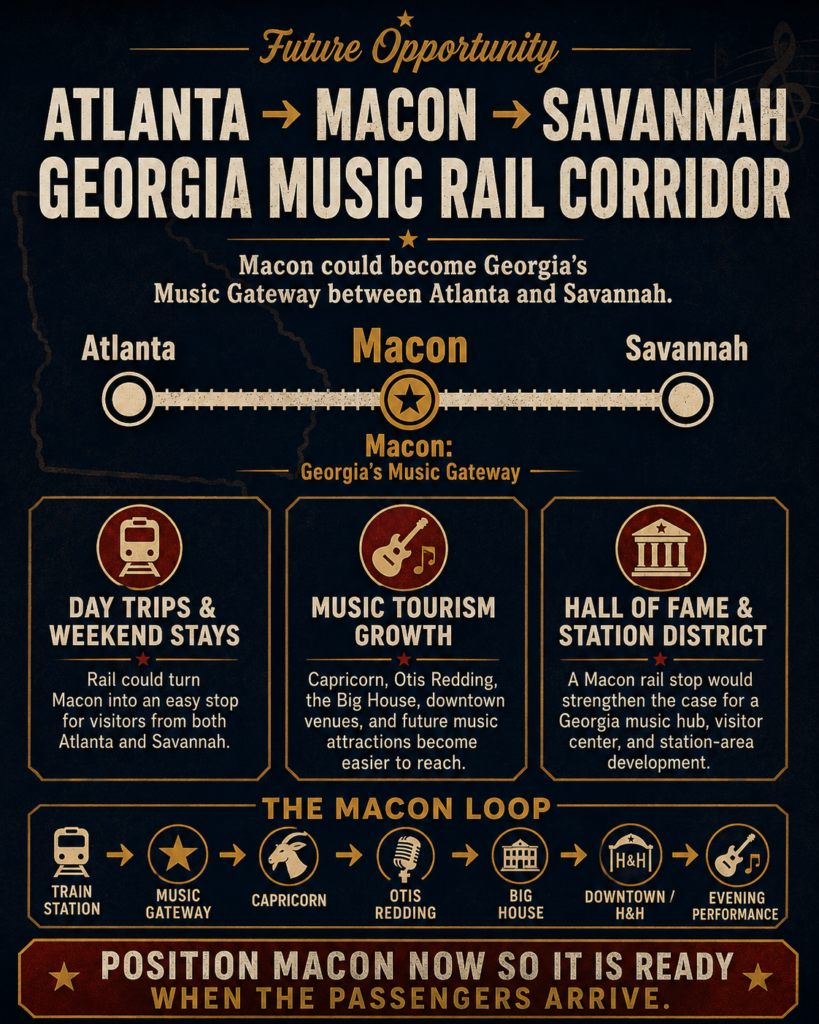
If Atlanta–Savannah passenger rail returns with a Macon stop, it could materially strengthen the case for Macon as a music-tourism destination, especially if service is fast, frequent, and tied into downtown transportation.
Georgia DOT is actively studying Atlanta–Savannah passenger rail now, and Macon is specifically identified as a potential station area. The 2026 State Rail Plan also notes public interest in Atlanta–Savannah service via Macon.
What changes for Macon
The biggest shift is psychological as much as logistical. Today, Macon is often treated as a place you deliberately drive to. Rail could make it a natural stop between two major tourism markets.
The corridor becomes:
Atlanta → Macon → Savannah
That puts Macon between:
- one of the Southeast’s largest population and air-travel hubs
- one of the Southeast’s strongest tourism destinations
If trains stop in Macon several times a day, Macon can start selling itself as a one-day stop, overnight stop, or music weekend, rather than requiring a dedicated automobile trip.
Music tourism is particularly well suited to rail
Imagine someone visiting Atlanta without a car.
They could take a morning train to Macon, spend the day doing:
Georgia Music Gateway → Capricorn → Otis Redding → H&H → Downtown → Rose Hill → Big House
Then either return to Atlanta or continue to Savannah.
That is a completely different tourism product.
The most important point is that Macon would need a tourism distribution system at the station. Rail by itself does not solve the last mile.
The ideal Macon arrival experience would be:
Train station
→ visitor/music orientation center
→ trolley / shuttle / golf-cart / bicycle options
→ attractions
→ restaurants
→ hotels
→ evening performance
→ train departure
That fits extremely well with the Visit Macon / music-gateway concept we’ve been discussing.
It could also strengthen the Hall of Fame argument
A recreated Georgia Music Hall of Fame becomes far more plausible if it can say:
“We sit directly on the Atlanta–Macon–Savannah passenger corridor.”
That statement changes funding discussions.
Instead of forecasting visitation almost entirely from motorists within a drive radius, you now have potential visitors arriving from two destination markets.
It also lets Macon position the Hall as something passengers encounter while traveling through Georgia, which fits the statewide institution concept much better than a conventional local museum.
A station could become part of the attraction
This is where Macon should think ahead.
Don’t build or select a station as simply:
platform + parking lot.
Treat it as an economic-development asset.
The station area could incorporate or connect directly to:
Visit Macon
Georgia Music Gateway
visitor orientation
bike/scooter/trolley rentals
event ticketing
hotel shuttle coordination
music exhibits
local food
Georgia products
Essentially:
Macon Music Station
That would make the arrival itself part of the city’s branding.
1985 Vineville becomes more interesting too
If the station location and transportation connections work, your proposed Vineville property could function as a secondary tourism hub or excursion center, particularly for groups.
One possible system:
Rail Station
→ downtown/Macon Music Gateway
→ trolley loop
→ Vineville visitor/event center
→ Big House
→ Capricorn
→ downtown
→ station
For bus groups, the Vineville property can still perform its original function:
presentation + food service + parking + tour dispatch + event/recording facility.
Rail adds another incoming audience rather than replacing motorcoach tourism.
The most important economic effect could be overnight stays
Day trips are useful.
Overnight visits are much more valuable.
A smart Macon package could be:
Friday: Atlanta → Macon train
Dinner + concert
Saturday: music heritage attractions + downtown + recording/performance experience
Sunday: brunch + museum/event → Savannah train
Or reverse it.
That effectively places Macon inside a three-city Georgia tourism itinerary rather than asking visitors to choose Macon instead of Atlanta or Savannah.
That is powerful positioning:
Atlanta. Macon. Savannah.
Three Georgia experiences. One rail corridor.
But “high-speed rail” needs a qualification
The current GDOT effort is a passenger-rail study. It does not yet mean true European/Japanese-style high-speed rail is committed. Georgia has previously studied higher-speed and dedicated-use alternatives, including Atlanta–Macon corridors, but route, technology, speed, stations, operating model and funding remain unresolved.
The distinction matters.
For Macon tourism, however, the train doesn’t necessarily need to run 200 mph.
The magic threshold is more practical:
frequent + reliable + downtown-accessible + faster/easier than driving.
If Atlanta–Macon were roughly an hour or somewhat more, rail becomes extremely compelling for leisure travel.
My strategic read
Rail would move my Macon music-destination assessment from roughly 8.5/10 to potentially 9.5/10.
Why?
Because Macon already possesses the difficult assets:
authentic history
historic sites
music institutions
tourism infrastructure
affordable real estate relative to Atlanta/Savannah
central geography
What it lacks is frictionless access.
Passenger rail attacks that weakness directly.
So I would incorporate rail into the long-range pitch now, but use careful language:
“Position Macon now to capitalize on potential Atlanta–Savannah passenger rail, with Macon serving as Georgia’s music gateway along the corridor.”
Don’t make the project dependent on rail happening.
Build the tourism ecosystem so that it works today.
If rail arrives, Macon is already waiting at the platform rather than scrambling to figure out what to do with the passengers.